
Texas Mold Rules Explained: The 25 Square Foot Line
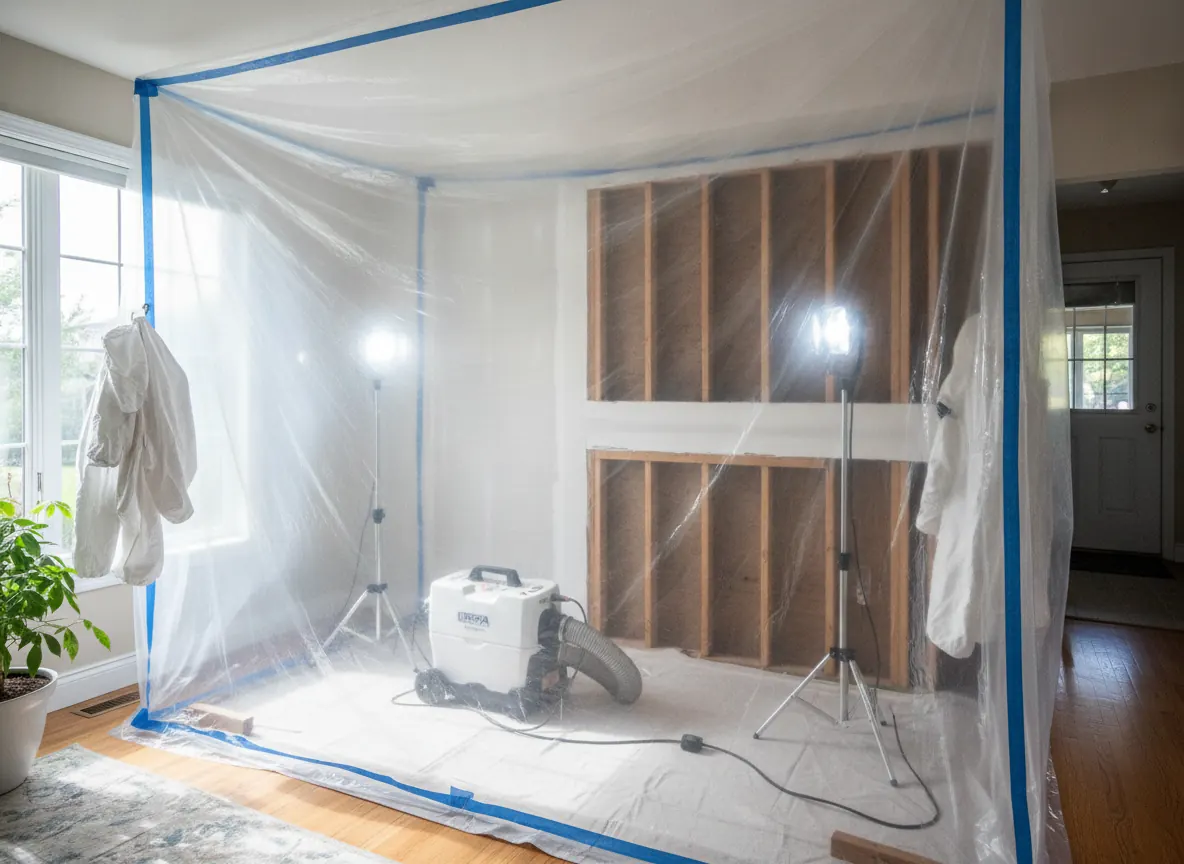
If you found mold in a house in Corpus Christi, TX, the first useful question is not what kind it is. It is how big the affected area is. Texas draws its main line at 25 contiguous square feet, and nearly everything about who may do the work, what paperwork you should get and how many companies are involved follows from that number.
The short version. Under 25 contiguous square feet, a homeowner can clean it themselves or hire anyone. At 25 sq ft or more, hired work needs licensed companies, a written protocol, a work plan, TDLR notification (5 days ahead, or the next business day in a water-damage emergency), a clearance assessment, and a Certificate of Mold Damage Remediation within 10 days. Texas requires TDLR licenses for mold assessment and remediation work on 25 or more contiguous square feet (Occ. Code §1958.101–.102). Verify any company at tdlr.texas.gov/LicenseSearch.
What do Texas mold laws actually cover?
Mold work in Texas is regulated by Occupations Code chapter 1958 (Mold Assessors and Remediators) and the Texas Department of Licensing and Regulation (TDLR) rules in 16 TAC chapter 78. The statute defines two separate activities:
- Mold assessment: "an inspection, investigation, or survey of a dwelling or other structure to provide the owner or occupant with information regarding the presence, identification, or evaluation of mold," plus writing a mold management plan or remediation protocol, and collecting or analyzing mold samples.
- Mold remediation: "the removal, cleaning, sanitizing, demolition, or other treatment, including preventive activities, of mold or mold-contaminated matter that was not purposely grown at that location."
A 2025 law, SB 1255 (effective September 1, 2025), amended the chapter. It now says it "applies only to the regulation of mold-related activities that affect indoor air quality." It also excludes routine cleaning, HVAC, plumbing and electrical diagnosis or repair "when not conducted for the purpose of mold assessment or mold remediation," real estate inspections, and "incidental discovery or emergency containment."
What does "25 contiguous square feet" mean?
The statute's wording is mold contamination that "affects a total surface area of 25 contiguous square feet or more." Contiguous means connected. A single patch 5 feet by 5 feet is 25 square feet. One 4 by 8 foot sheet of drywall is 32 square feet, so a fully stained sheet is already over the line.
Measure the surface, not the room. If you are not sure whether separate patches count together, or whether mold has spread behind the wall, that is a question for a licensed mold assessment consultant, because what you can see is often less than what is there.
Who can clean mold without a license in Texas?
Chapter 1958 has several exemptions, each narrower than it sounds.
- Small areas, anyone: "A person is not required to be licensed ... to perform mold remediation in an area in which the mold contamination affects a total surface area for the project of less than 25 contiguous square feet" (§1958.102(c)). TDLR's 2025 consumer sheet puts it this way: "In most instances, areas of visible mold less than 25 contiguous square feet in area may be cleaned or removed by people who are not licensed."
- Owners and tenants on their own property: an owner or tenant, or their managing agent or employee, does not need a license on property they own or lease (§1958.102(a)). That exemption does not apply at 25 contiguous square feet or more, or when the agent or employee does mold work for the public.
- Small residential owners: as the statute reads, an owner (or the owner's managing agent or employee) of residential property "with fewer than 10 dwelling units" is not required to be licensed (§1958.102(e)), and TDLR's rule says this applies "regardless of the total surface area" (16 TAC 78.30). It covers the owner's own work, not hired, unlicensed help.
Two cautions. TDLR's FAQ says "a licensed MRC performing a small mold remediation project (less than 25 contiguous square feet) is not exempt from the law and rules." If you hire a licensed company for a small job, its license rules still apply. And 16 TAC 78.30 says an unlicensed person working under the small-area exemption who finds more mold, bringing the total to 25 square feet or more, loses the exemption. If that happens to you, stop and ask a licensed assessor or TDLR how to proceed.
What changes at 25 square feet or more?
Once a hired job reaches the line, Texas expects a defined sequence. In practice it looks like this:
Licensed assessment and protocol
A TDLR-licensed mold assessment consultant inspects and writes a project-specific remediation protocol: what gets removed or cleaned, where, and what counts as passing.
Work plan from a separate company
A licensed mold remediation contractor, from a different company, writes a work plan based on that protocol.
TDLR notification
The remediator notifies TDLR "not later than the fifth day before" starting. In an emergency, notice is due "not later than the next business day," and the statute says an emergency exists "if a delay in mold remediation services in response to a water damage occurrence would increase mold contamination." TDLR's At a Glance sheet lists a $25 fee for an owner-occupied residential notification.
Remediation and clearance
The remediator does the work under containment. A licensed consultant then performs the clearance assessment.
Photos and certificate
Within ten calendar days after the project stop-date, the remediator must give you before-and-after photographs (16 TAC 78.150). Within 10 days of finishing, the license holder must give you the Certificate of Mold Damage Remediation (§1958.154).
| Question | Under 25 contiguous sq ft | 25 contiguous sq ft or more |
|---|---|---|
| Can the owner do it? | Yes | Owners of residential property with fewer than 10 units are exempt from licensing (§1958.102(e)); hired work needs licensed companies |
| Can you hire anyone? | Generally yes | No; licensed assessor and licensed remediator |
| Written protocol and work plan | Not required by the 25 sq ft rule | Yes |
| TDLR notification | "No notification requirement" (TDLR) | 5 days ahead, or next business day in a water-damage emergency |
| Clearance and CMDR | Optional; a consultant can sign the certificate's bottom section | Clearance assessment, then CMDR within 10 days |
Can the same company test for mold and remove it?
No. In Texas, the company that assesses your mold and writes the protocol cannot be the company that removes it on the same project, and one owner can't hold both (Occ. Code §1958.155). Subsection (a) says "a license holder may not perform both mold assessment and mold remediation on the same project," and subsection (b) bars owning an interest in both the assessing and remediating entities on that project.
That means two companies and two bills on a larger job. Read more on mold inspection and testing and on what mold removal and remediation typically involves.
What is the Certificate of Mold Damage Remediation?
Ask for the Certificate of Mold Damage Remediation (TDI form MDR-1). Insurers can't make underwriting decisions based on remediated mold damage when you have it (Ins. Code §544.303), and you must give buyers copies from the last five years (§1958.154(b)).
The certificate includes a licensed assessment consultant's statement that the mold identified for the project "has been remediated as outlined in the mold management plan or remediation protocol." If the consultant finds the underlying cause has been fixed so that it is "reasonably certain that the mold will not return from that remediated cause," that box is marked too. Keep it with your house records. It does not guarantee insurance or a sale.
Does the 25 square foot rule change after a hurricane?
Not in the way people sometimes assume. The 2025 amendments exclude "demolition of a structure after a fire or other disaster." That covers demolition, not mold remediation, so do not treat storm mold cleanup as exempt. What does change after a water event is timing: the emergency notification rule lets a licensed remediator start sooner and notify TDLR by the next business day. See mold after a hurricane or flood for the storm side.
What it costs on either side of the line
Published national estimates, not quotes: This Old House (Mar 2026) lists $10–$25 per square foot and $500–$1,250 for 50 square feet; Fixr (Jan 2025) lists a standalone inspection at $450–$800. The full table and a planning calculator are on the mold remediation cost page for Corpus Christi. Quotes come from independent companies, not this site.
Frequently asked questions
Can I remove mold myself in Texas?
Under 25 contiguous square feet, yes: a homeowner can clean it themselves or hire anyone. The statute also exempts owners of residential property with fewer than 10 dwelling units from licensing for their own work regardless of size, but that does not cover hired helpers, and larger areas usually call for a licensed assessment first.
Is 25 square feet the cutoff for licensed mold remediation in Texas?
Yes. Texas requires TDLR licenses for mold assessment and remediation work on 25 or more contiguous square feet (Occ. Code §1958.101–.102). At that size, hired work needs a written protocol, a work plan, TDLR notification, a clearance assessment and a Certificate of Mold Damage Remediation within 10 days.
Who notifies TDLR about a mold job, and when?
The licensed remediator does, no later than the fifth day before starting work on a 25+ square foot project. In a water-damage emergency, where waiting would increase contamination, notice is due by the next business day. TDLR lists a $25 fee for an owner-occupied residential notification.
Does a licensed company have to follow the rules on a small job?
Yes. TDLR's FAQ says a licensed remediation contractor doing a project under 25 contiguous square feet is not exempt from the law and rules. The small-area exemption is for unlicensed people, not for licensees.
Corpus Christi Mold Remediation is a free quote service, not a mold company. You describe the problem once, and independent mold inspection and remediation companies serving Corpus Christi and the Coastal Bend may reply with quotes. Companies may pay to receive requests, and they reply on their own schedules. Request free quotes or call (361) 247-3040.