
Condo and Vacation Rental Mold on Padre Island and Port Aransas
A Padre Island condo or a Port Aransas vacation rental can sit closed for weeks between guests or owner visits. In the Coastal Bend's summer air, that is when musty smells, spotted vents and damp closets show up. This guide covers why it happens, a between-visit checklist, the hard question of who is responsible in a condo, and the Texas rules that apply to cleanup and rebuilding.
Corpus Christi Mold Remediation is a free quote service, not a mold company. You describe the problem once, and independent mold inspection and remediation companies may reply with quotes. Some of those companies may pay to receive requests, and they reply on their own schedules.
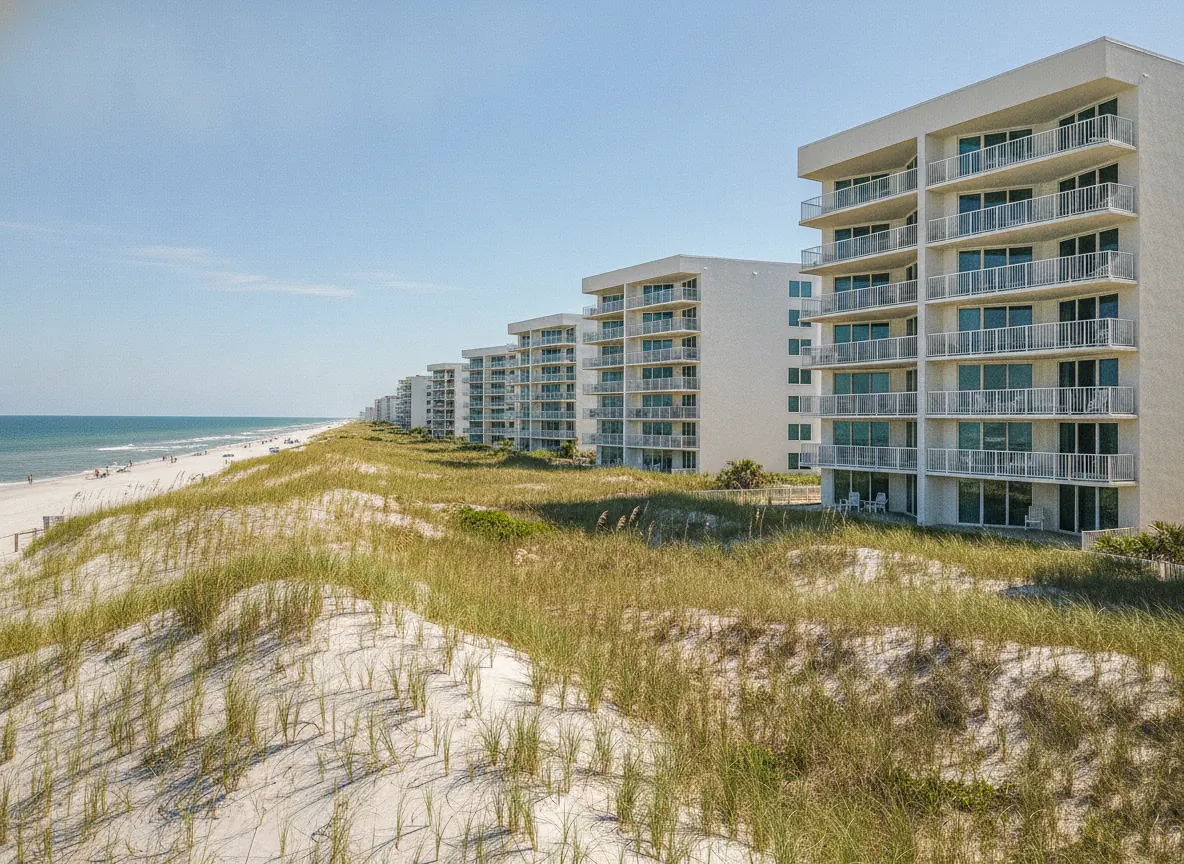
Island housing is different
The upper part of North Padre Island is a district of the City of Corpus Christi, TX. Wikipedia describes "The Island" as "high-income residential housing and condominiums," with neighborhoods "connected by a series of canals which lead to the Gulf of Mexico." Packery Channel separates North Padre Island from Mustang Island, where Port Aransas is the only established town.
Census figures show how many homes here are part-time:
| Area | Figure | Source |
|---|---|---|
| Port Aransas (city) | 36.4% of housing units held for seasonal, recreational or occasional use | ACS 2020–24 5-yr, computed |
| Port Aransas (city) | 4,852 housing units, 71.1% vacant | 2020 Census, via Wikipedia |
| 78418 ZIP area (Flour Bluff and Padre Island combined) | 11.9% seasonal-vacant | ACS 2020–24 5-yr, computed |
| City of Corpus Christi | 2.4% seasonal-vacant | ACS 2020–24 5-yr, computed |
The 78418 figure covers both Flour Bluff and Padre Island; there is no island-only figure.
Why closed-up units grow mold
The outdoor air carries a lot of water. NOAA's 1991–2020 normals for Corpus Christi International Airport show summer dew points averaging about 74°F, about 123 days a year at 90°F or hotter, about 32 inches of rain a year, and September as the wettest month.
As general building science, any surface cooler than the dew point can collect condensation. In a condo that can mean supply registers, ducts, cold-water lines and the back of drywall in a unit kept very cold. When the AC is off or cycling rarely, indoor humidity can climb toward outdoor levels. EPA's moisture guidance is widely cited for keeping indoor relative humidity below 60% (ideally 30–50%); check epa.gov/mold for the current wording. Our AC and HVAC mold guide covers air handlers, drains and vents.
A between-visit checklist
General advice for owners and managers, not a rule:
- Leave the AC on a setting that keeps running often enough to pull moisture, rather than off. Ask your HVAC contractor what fits your unit.
- Check the AC condensate drain and pan before you leave and when you arrive.
- Look at supply vents, closet walls and under sinks for spots or damp areas.
- Have someone check the unit after heavy rain or a storm, and after a long vacancy.
- Note musty smells in guest reviews or cleaning reports and follow up quickly.
- Check ground-level enclosures and storage on raised homes, which sit below the flood elevation on many coastal lots.
Condo mold: who is responsible, the association or the owner?
This is the question owners ask most, and it is the one this site cannot answer for you. Who handles mold in a condo usually depends on where the water came from and what the condominium documents say about the unit, the common elements and insurance. Texas condominium law was not covered in the research behind this guide.
Check your declaration and bylaws. Read how they define the unit and the common elements, who maintains pipes, roofs and AC equipment, and how water damage is handled. Then ask the association or manager in writing, and talk to a Texas attorney if there is a dispute. Ask your insurance agent what your unit-owner policy covers.
For insurance in general, TDI says most home policies cover "Sudden and accidental release of water or smoke," but not "A continuous water leak; policies also won't cover mold removal, except to repair damage caused by a covered risk." On the coast, wind and hail may be under TWIA, flood is a separate policy (most flood policies have a 30-day wait), and mold follows the cause. Many policies cap or exclude mold; check your declarations page.
If you rent out a unit long term, Texas Property Code repair rules can apply. See rental and landlord mold and is my landlord responsible for mold in Texas?
Storm history on the islands
Hanna made landfall on Padre Island on July 25, 2020. Its 6.24 ft surge at the Bob Hall Pier gauge was the highest measured for that storm, and the surge and waves "severely damaged the Bob Hall Pier on Padre Island" (NHC). Harvey's surge in 2017 "damaged or destroyed many coastal structures in Port Aransas, ... North Padre Island and Mustang Island," and erosion near Packery Channel cut Port Aransas's main water supply for six days (NHC). After any storm, our hurricane and flood mold guide covers drying and documentation.
Texas rules for cleanup in a condo or rental
Texas requires TDLR licenses for mold assessment and remediation work on 25 or more contiguous square feet (Occ. Code §1958.101–.102). Verify any company at tdlr.texas.gov/LicenseSearch. In Texas, the company that assesses your mold and writes the protocol cannot be the company that removes it on the same project, and one owner can't hold both (Occ. Code §1958.155).
The 25 square foot line: Under 25 contiguous square feet, a homeowner can clean it themselves or hire anyone. At 25 sq ft or more, hired work needs licensed companies, a written protocol, a work plan, TDLR notification (5 days ahead, or the next business day in a water-damage emergency), a clearance assessment, and a Certificate of Mold Damage Remediation within 10 days.
Owners of residential property with fewer than 10 units are generally exempt from licensing at any size (§1958.102(e)), but how that applies to a single condo unit inside a larger building is a question for the statute or an attorney. The companies you hire still need licenses for jobs of 25 square feet or more. Ask for the Certificate of Mold Damage Remediation (TDI form MDR-1). Insurers can't make underwriting decisions based on remediated mold damage when you have it (Ins. Code §544.303), and you must give buyers copies from the last five years (§1958.154(b)).
Permits for the rebuild
Mold cleanup itself usually isn't permitted work, but rebuilding often is. Padre Island is inside the City of Corpus Christi, where interior remodeling, roofing and foundation repairs use Form 1003, plus an elevation certificate in a floodplain. Beachfront projects may need a Beachfront Construction Certificate or a Dune Protection Permit. Port Aransas is its own city, so check with the city building department there. Nueces County is in TDI's catastrophe area, so coastal rebuilds may need a windstorm (WPI-8) inspection.
Cost and next steps
Published national estimates put a standalone mold inspection at $450–$800 (Fixr, Jan 2025), HVAC and duct work at $3,000–$10,000 (Fixr; This Old House), and overall remediation at $1,500–$9,000 (Fixr, Aug 2025). See the Corpus Christi mold remediation cost guide for the full table. Quotes come from independent companies, not this site.
Local pages: mold remediation on Padre Island and mold remediation in Port Aransas. To get quotes, describe the unit and the problem once or call (361) 247-3040.
Frequently asked questions
Who pays for mold in a condo, the association or the owner?
It usually depends on where the water came from and what the condominium documents say. Check your declaration and bylaws for how the unit and common elements are defined and who maintains pipes, roofs and AC equipment, ask the association in writing, and talk to a Texas attorney if there is a dispute. This is not legal advice.
Should I turn off the AC in a vacation rental between guests?
As general building science, an AC that is off lets indoor humidity climb toward outdoor levels, and Corpus Christi summer dew points average about 74 degrees F (NOAA 1991 to 2020). Many owners leave it on a setting that still runs often enough to pull moisture. Ask your HVAC contractor what fits your unit.
Do I need a license to clean mold in my own condo in Texas?
Under 25 contiguous square feet, an owner can clean it themselves or hire anyone. Owners of residential property with fewer than 10 units are generally exempt at any size, but how that applies to one condo unit is a question for the statute or an attorney. Companies you hire need TDLR licenses for jobs of 25 square feet or more.
Do I need a permit to rebuild after mold on Padre Island?
Mold cleanup itself usually isn't permitted work, but rebuilding often is. Padre Island is in the City of Corpus Christi, where interior remodeling uses Form 1003, plus an elevation certificate in a floodplain. Beachfront work may need more, and coastal rebuilds may need a TDI windstorm inspection.