
Mold After a Hurricane in Corpus Christi: What to Check Now
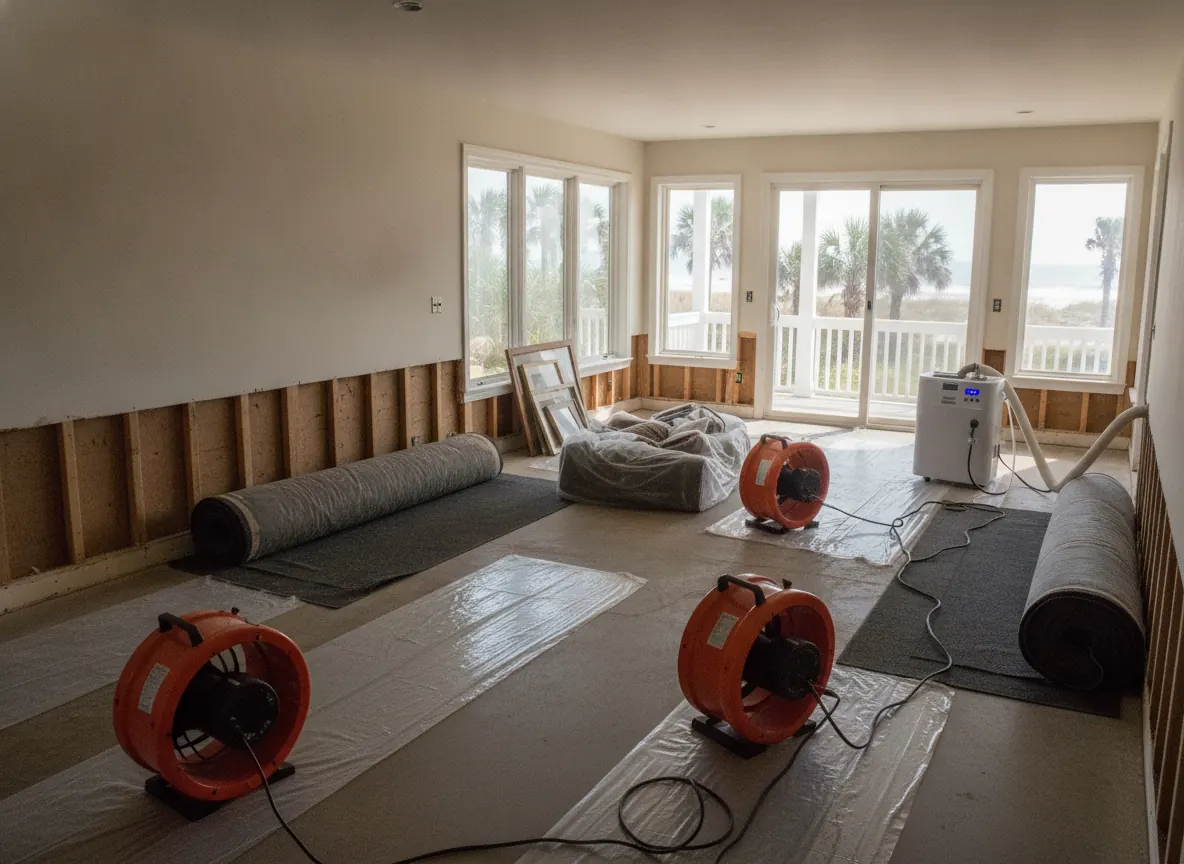
After a hurricane or a flood in Corpus Christi, TX, the water is the emergency and mold is the follow-up. This guide covers what to check once it is safe to go back inside, how Texas mold rules apply after a storm, and how to avoid the problems that tend to show up with fast, high-pressure repairs. It is general guidance, not a substitute for local emergency instructions.
The first days, in order. Stay out until officials say it is safe. Stop any active water if you can. Photograph everything before cleanup. Start drying: EPA's mold guidance is widely cited for drying wet materials within 24–48 hours to help prevent mold growth. Then check licenses before you hire: Texas requires TDLR licenses for mold assessment and remediation work on 25 or more contiguous square feet (Occ. Code §1958.101–.102). Verify any company at tdlr.texas.gov/LicenseSearch.
How soon does mold grow after a hurricane or flood?
There is no exact clock, but speed matters. EPA's consumer guidance is commonly summarized as: dry wet building materials and furnishings within 24–48 hours. After a big storm, that window is hard to meet. Power may be out, roads may be closed and every company in the region is busy.
Local weather makes it harder. NOAA's 1991–2020 normals for Corpus Christi International Airport put summer dew points at about 74°F on average, and September, the peak of hurricane season, is the area's wettest month. As general building science, moist outdoor air does not help a soaked house dry, and a house without working AC tends to hold humidity. Fans pulling in humid air are not the same as dehumidification.
What past storms tell the Coastal Bend
Storm history is a reason to inspect carefully, not a reason to panic. A few dated facts from federal sources:
| Storm | Date | What the record says |
|---|---|---|
| 1919 hurricane | Sept 14, 1919 | North Beach "was swept clean of all but three badly battered buildings," and surge reached up to 16 feet across the barrier islands (Nueces County Flood Insurance Study). The bayfront seawall followed and was completed in 1940. |
| Hurricane Celia | Aug 3, 1970 | Came ashore near Aransas Pass and Port Aransas with gusts estimated as high as 180 mph; the NWS reports roughly 9,000 Coastal Bend homes destroyed and 70% of Corpus Christi residences damaged. NWS pages differ on its category. |
| Hurricane Harvey | Aug 25, 2017 | Landfall "about 5 n mi east of Rockport." About 15,000 homes destroyed and 25,000 damaged in the landfall counties (NHC). Corpus Christi had "widespread but mostly minor damage," and about 220,000 customers lost power at the peak. |
| Hurricane Hanna | July 25, 2020 | Landfall on Padre Island; the highest measured surge was 6.24 feet above normal tide at Bob Hall Pier (NHC). |
| Hurricane Beryl | 2024 | The most recent federal hurricane declaration for the area (2024, public assistance). Landfall was near Matagorda. |
Harvey's widespread power loss is a useful reminder: a house can take little direct water and still sit closed, hot and humid for days.
Where to check for mold after the water goes down
These are general building checks, not a diagnosis:
- Lower walls: wet drywall, swollen baseboards and stains that wick upward from the floor. Mold often grows inside the wall cavity first. See wall and drywall mold.
- Floors and cabinets: under carpet pad, laminate and vinyl, and inside base cabinets that sat in water.
- Ceilings and attics: roof or window damage can let wind-driven rain into attic insulation and decking. See attic mold.
- AC system: after an outage or flooding, check the air handler, drain pan and supply vents for musty odor or spotting. See AC and HVAC mold.
- Elevated homes: on Padre Island and other coastal lots, enclosed ground-floor storage below the flood elevation can collect water and stay damp. Check it early.
- Contents: soaked mattresses, upholstery and cardboard boxes are hard to dry fully.
A musty smell with no visible mold is still worth an assessment, especially behind walls that got wet.
Do Texas mold rules still apply after a storm?
Yes. Under 25 contiguous square feet, a homeowner can clean it themselves or hire anyone. At 25 sq ft or more, hired work needs licensed companies, a written protocol, a work plan, TDLR notification (5 days ahead, or the next business day in a water-damage emergency), a clearance assessment, and a Certificate of Mold Damage Remediation within 10 days.
The 2025 amendments to chapter 1958 exclude "demolition of a structure after a fire or other disaster." That covers demolition, not remediation, so do not assume storm mold cleanup is exempt. And the separation rule still holds: in Texas, the company that assesses your mold and writes the protocol cannot be the company that removes it on the same project, and one owner can't hold both (Occ. Code §1958.155). More detail is in Texas mold rules and the 25 square foot line.
Flood, wind or TWIA: which claim?
On the coast, the cause of the water decides which policy may respond. TDI notes that a coastal home policy might not cover wind and hail, which TWIA sells for coastal residents, and that most home policies don't cover flood. Most flood policies have a 30-day waiting period. As a general rule, mold follows the cause. Photograph everything before tear-out and call your insurers early. No one can promise coverage; see does insurance cover mold in Texas.
How to avoid storm-chaser problems
General advice, based on Texas law and common sense:
- Verify the TDLR license of both the assessor and the remediator before you sign.
- Get the remediation protocol and the work plan in writing before work starts.
- Do not pay in full upfront.
- Know your cancellation right. Texas Business and Commerce Code chapter 601 generally lets a consumer cancel an in-home sale over $25 until midnight of the third business day after signing. Whether it applies depends on the transaction, so read the cancellation notice in the contract.
- Be cautious with anyone who offers to test and remove the mold on the same job. That is not allowed in Texas.
Rebuilding: permits and windstorm inspections
Mold cleanup itself usually isn't permitted work, but rebuilding often is. In the City of Corpus Christi, including Flour Bluff and Padre Island, interior remodeling, roofing and foundation repairs use Form 1003, plus an elevation certificate if the property is in a floodplain. Windstorm-related repairs need an engineer, according to the City's residential repairs page.
If mold work uncovers roof-deck, framing or window damage, the rebuild may need a TDI windstorm inspection (WPI-8) to keep TWIA eligibility. Your rebuild contractor should confirm. TDI says most new construction, roof replacements, major repairs and other alterations need an inspection; roof repairs under 100 square feet that don't involve decking, window or door glass replacement, and painting, carpeting and cabinets are exempt. Outside Corpus Christi, check with your city building department.
Renters: if storm damage causes the problem, Texas Property Code §92.054 says the landlord's repair period does not begin until the landlord receives the insurance proceeds. See rental mold; this is not legal advice. For budgeting, the mold remediation cost page lists published ranges.
Frequently asked questions
How soon after a hurricane should I check for mold?
As soon as it is safe to go inside. EPA's guidance is widely cited for drying wet materials within 24 to 48 hours to help prevent mold growth. Photograph the damage first, then start drying, and check lower walls, floors, cabinets, attics and the AC system.
Is storm mold cleanup exempt from Texas licensing?
No. The 2025 amendments exclude demolition of a structure after a disaster, which is not the same as mold remediation. At 25 contiguous square feet or more, hired work still needs licensed companies, a protocol, a work plan, TDLR notification, clearance and a certificate. In a water-damage emergency, notification can be made by the next business day.
Do I need a permit to rebuild after mold removal in Corpus Christi?
Mold cleanup itself usually isn't permitted work, but rebuilding often is. In Corpus Christi, interior remodeling, roofing and foundation repairs use Form 1003, plus an elevation certificate in a floodplain. Coastal rebuilds may also need a TDI windstorm (WPI-8) inspection.
Can I buy flood insurance after a hurricane forms?
TDI says most flood policies have a 30-day waiting period, so coverage bought after a storm forms usually will not apply to that storm. TDI also notes TWIA won't sell a policy while there is a hurricane in the Gulf.
Corpus Christi Mold Remediation is a free quote service, not a mold company. You describe the problem once, and independent mold inspection and remediation companies serving Corpus Christi and the Coastal Bend may reply with quotes. Companies may pay to receive requests, and they reply on their own schedules. Request free quotes or call (361) 247-3040.